





 0

Chinese imports of pork and pork by-products totaled 1.44 million metric tons between January and September 2026, down 15.3% from the 1.70 million metric tons imported in the same period in 2025, according to the data analyzed.
The decline is mainly due to a drop in pork purchases, which fell from 780,000 metric tons in the first nine months of 2025 to 570,000 metric tons in 2026, representing a 26.9% decrease. Meanwhile, imports of pork by-products remained relatively stable, although they also declined. Between January and September 2026, they totaled 870,000 metric tons, compared to 920,000 metric tons during the same period the previous year—a 5.4% decrease.

Compared to January-September 2020, when imports of pork and offal totaled 4.32 million metric tons, the volume imported so far this year is 66.7% lower. The decline has been particularly sharp for pork, with imports down 82.6% compared to 2020, while imports of offal have fallen by 16.3%.
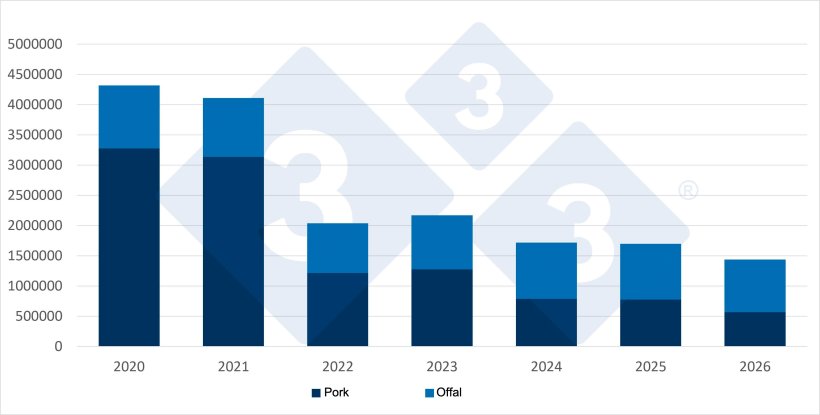
Trends in Chinese imports of pork and pork by-products, in metric tons, from January through September of each year. Source: 333, based on data from the General Administration of Customs of China.
Changes in Chinese demand for pork
Trends in recent years show a shift in China’s import demand, with offal accounting for a growing share of imports. So far this year, offal has come to account for 60.4% of the total import volume, compared with 54.1% during the same period in 2025.
This change is even more significant when compared to 2020. In the first nine months of 2020, pork accounted for approximately 75.8% of China’s total import volume, while offal accounted for 24.2%. Six years later, the situation has reversed: between January and September 2026, pork accounted for only 39.6% of imports, compared with 60.4% for offal. Thus, pork’s share of China’s pork and pork by-product imports has declined by 36.2 percentage points since 2020.
October 22, 2026/ 3tres3 Staff with data from China's General Administration of Customs Supervision.